You know how sometimes, you stumble upon a piece of news, maybe just a blurb, and it just… sticks with you? Like a little cosmic burr in your mind, prompting you to ponder things far beyond your morning coffee. Well, that happened to me last week. It was about astronomers, bless their dedicated hearts, opening up what they’re calling a ‘new window’ on exoplanets – those incredible worlds spinning around distant stars. And what they found? Well, it’s pretty mind-blowing, and honestly, a little humbling.
Turns out, for a planet to be, you know, *habitable* – to have liquid water, an atmosphere, all that good stuff we kinda take for granted here on Earth – it needs an invisible shield. A magnetosphere. Think of it like a planet’s personal force field, deflecting all the nasty solar winds that would otherwise strip away its precious air and water. Mars, our rusty neighbor? Lost its atmosphere, and with it, its flowing water, because its magnetosphere basically packed up and left. Sad, right?
For fifteen years, scientists have been scratching their heads, trying to *directly* measure these magnetic fields on planets outside our solar system. It’s like trying to feel the wind on a feather from a mile away. But this team, led by Julia Seidel, didn’t actually set out to find magnetospheres. Nope. They were just trying to measure wind speeds on seven super-hot, Jupiter-like gas giants. Talk about a happy accident!
These planets, by the way, are tidally locked, meaning one side is always facing its star, perpetually scorching, while the other is in eternal, freezing night. You’d expect the winds to be absolutely screaming across these temperature extremes, wouldn’t you? But here’s the kicker: the hotter the planet, the *slower* the wind. Totally counterintuitive. As Vivien Parmentier, another researcher, put it, “Something must happen that slows down the wind speeds for hotter objects!” And that ‘something’? You guessed it: powerful magnetic fields, acting as a cosmic brake, slowing down those charged particles in the atmosphere. They’re like Jupiter’s or Saturn’s, but on these distant worlds.
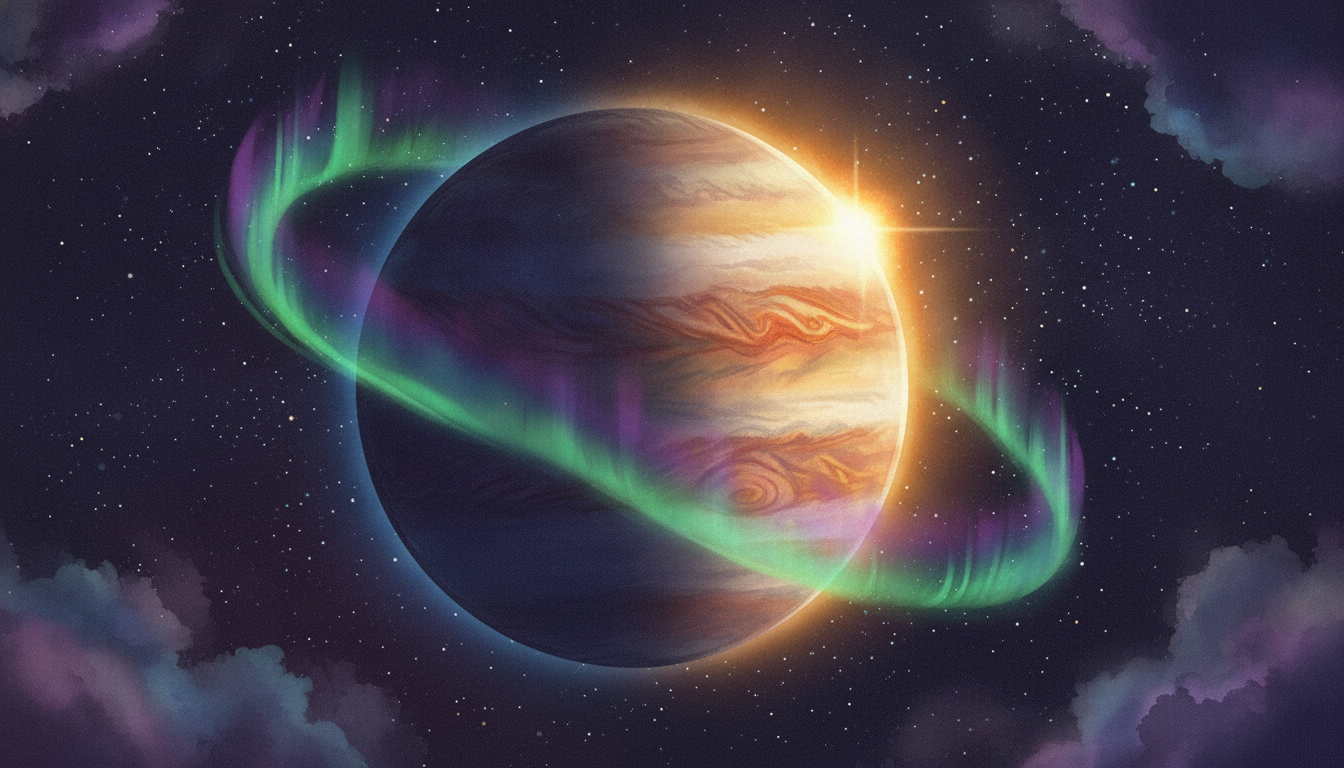
Imagine the aurorae on these planets, Bibiana Prinoth from ESO mused. We see our beautiful Northern and Southern Lights, right? Well, on these exoplanets, where the magnetic fields are wrestling with super-fast winds, those light shows could be even more dramatic. Just breathtaking. It really makes you pause, doesn’t it? Thinking about these unseen forces, miles and light-years away, shaping entire worlds.
The 508 Takeaway
This whole discovery, this peek into the universe’s intricate workings, really got me thinking about the unseen forces in our own lives. We often focus on the tangible, the things we can see and touch, the obvious challenges or joys. But what about the invisible shields that protect *us*? The quiet acts of kindness that buffer a hard day. The steady, unwavering support from a friend or family member. The resilience within us that we don’t even notice until we need it. These magnetospheres of our human experience, they’re not always flashy, not always celebrated, but they’re absolutely vital for keeping our own inner world habitable, for nurturing our ‘atmosphere’ of peace and connection. It’s a beautiful reminder to appreciate those subtle, foundational elements – both in the cosmos and right here, in our everyday moments – that allow us to truly thrive.
This story was originally reported by Andy Corbley. You can read the full original article here.