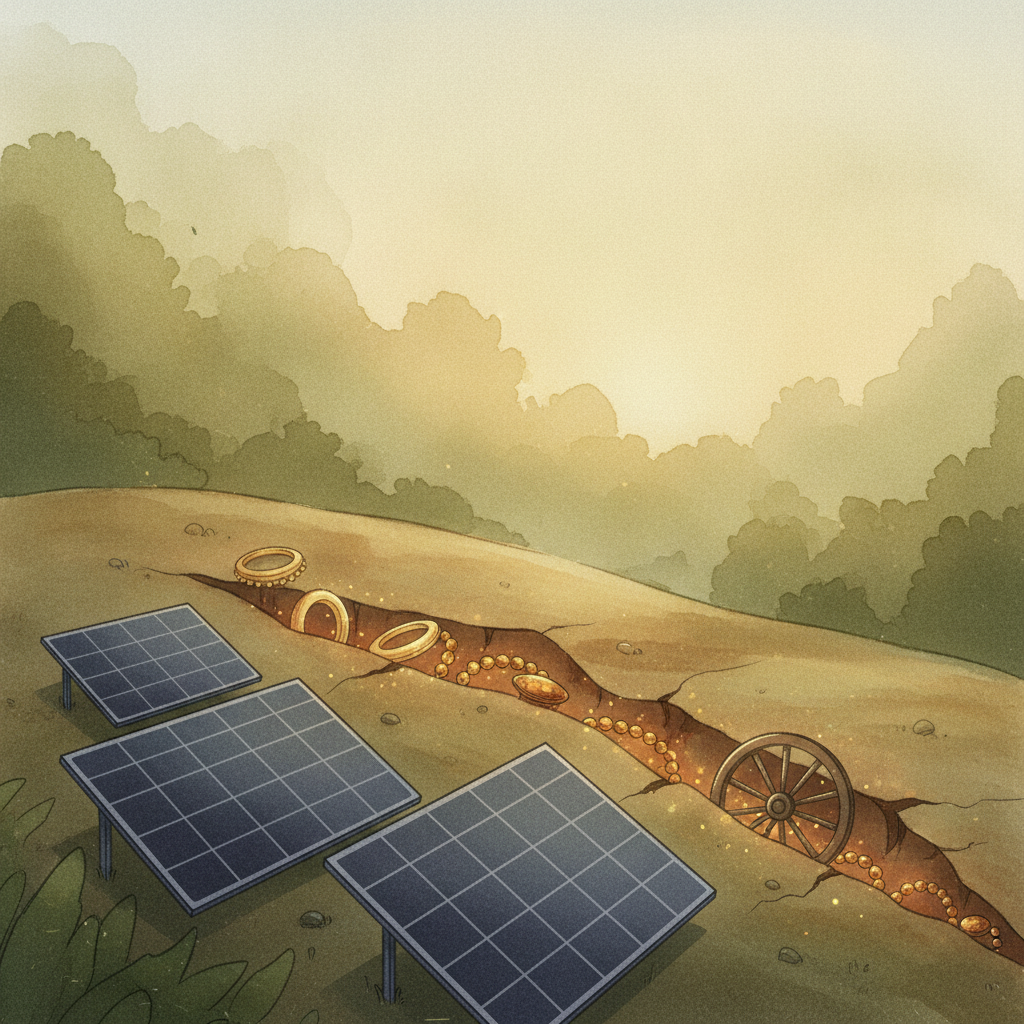
Picture this: a plot of land in Bad Camberg, Germany, not far from the hustle and bustle of the A3 highway. The ground’s being prepped, you know, for a solar panel installation – pretty standard stuff, very modern, very practical. Nobody’s expecting anything particularly mind-blowing. But then there’s Kai Mückenberger, a district archaeologist, called in as a consultant. He ordered a geomagnetic survey, a bit of a routine, chop-chop, expecting, honestly, to find nothing more exciting than the outlines of some old building foundations. He even tossed out a joke to his team, half-muttering, “Maybe we’ll find a princely grave!” Go figure, right?
Well, as fate would have it, that joke turned out to be less of a joke and more of a prophecy. The survey showed a curious rectangle within a circle. Still, Mückenberger wasn’t holding his breath. Then the earth-moving crews called him, their voices buzzing with a certain kind of urgency: they’d hit metal. Not just any metal, a spearhead. That’s when things got real, and fast. Suddenly, the routine consultation became the archaeological equivalent of hitting the jackpot.
What followed, honestly, reads like something out of an Indiana Jones movie. Mückenberger and his team carefully excavated, unearthing heavy, gleaming gold jewelry – one ring alone weighed five ounces, imagine! – along with shimmering amber, delicate bronze and glass beads. There was even a small knife, and, most incredibly, the iron fittings of an ancient chariot or wagon: hubcaps, an axle, and the bands that would have hugged the wooden wheels like ancient tires. It was, as the experts at the State Office for Monument Preservation later put it, an “absolute top” discovery; Mückenberger himself said it’s a once-in-a-career find. And get this: they found a stunning beaked bronze jug for wine or water, crafted by the Etruscans, a central-Italian tribe. Talk about ancient trade routes!
They didn’t just pick out the bits and pieces, either. To ensure the best preservation, they removed the entire assemblage in a giant block of dirt. This grave, dating back to the first half of the 5th century BCE, is now considered one of only three comparable “wagon burials” in all of Germany, tentatively ascribed to the Hunsrück-Eifel Celtic culture. It’s an almost unparalleled glimpse into a rich, ancient world right beneath our feet, a world we hardly ever think about.
The 508 Takeaway
Isn’t it amazing how the most extraordinary things can hide beneath the most ordinary circumstances? One minute, you’re planning for solar panels, the next, you’re uncovering a 2,500-year-old princely tomb. It makes you pause, doesn’t it? It reminds me that often, the magic isn’t in a grand, distant quest, but right here, under the surface of our everyday lives. Maybe it’s not a Celtic prince, but a forgotten memory, a hidden talent, or a simple moment of pure joy waiting to be unearthed. This story, for me, is a beautiful nudge to approach our world with a little more curiosity, a dash of wonder, and the open-hearted readiness to discover something truly priceless, even in the most mundane of places. It’s about finding the ancient awe in the modern everyday.
This story was originally reported by Andy Corbley. You can read the full original article here.