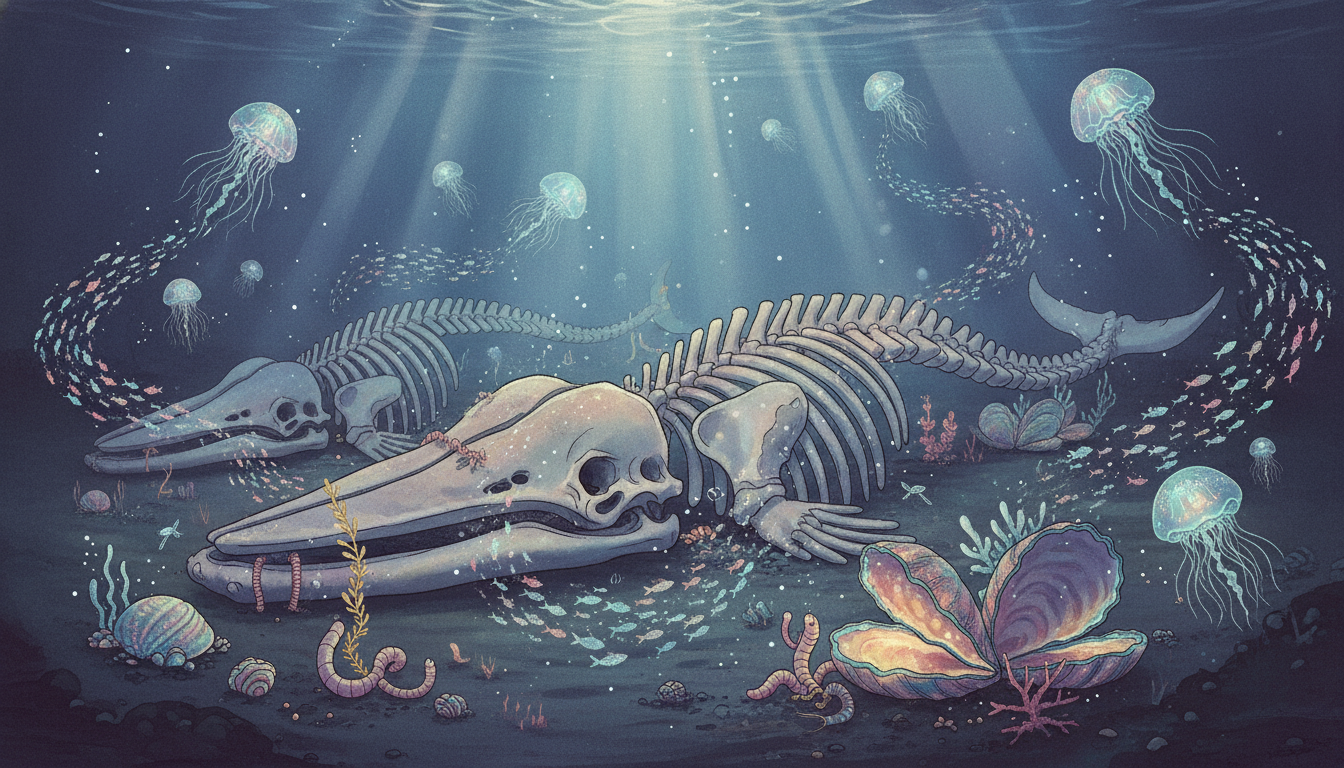
You know how sometimes you hear about something, and it just… reshapes your entire understanding of the world, like a little mental earthquake? That happened to me just the other day, reading about a truly mind-boggling discovery deep, deep under the Indian Ocean. We’re talking 20,000 feet down, in a place called the Diamantina Fracture Zone – a spot so remote and dark, you’d think nothing could possibly thrive there.
But oh, were we wrong. Chinese scientists, Xiaotong Peng and Peng Zhou among them, went down in submersibles expecting to find *some* whale remains. What they actually stumbled upon? The world’s largest “whale graveyard.” A necropolis, they called it, of an unimaginable scale. It wasn’t just a few bones; it was almost 500 skeletons, with an estimated 10 *million* dead whales stretching across a 660-mile-long area. Just wrap your head around that for a second. Millions of leviathans, resting in the abyss.
Now, here’s the really incredible part, the bit that just gives me chills: this supposed graveyard isn’t dead at all. No, no, no. It’s *teeming* with life. Bivalves, brittle stars, all sorts of worms, jellyfish – many of them species that science has never even seen before, just living their best lives down there. These whale carcasses, these “whale falls,” are a literal lifeline, a feast in the dark, offering sustenance to creatures that simply wouldn’t exist without them. It’s like finding a bustling, vibrant city in the middle of a desert, built entirely on the foundations of ancient giants.
Scientists are calling it an “evolutionary hotspot,” a place where life doesn’t just survive, but innovates. It turns out, the bounty from a decaying whale can offer similar nutrients to what these deep-sea critters find near hydrothermal vents – those fiery, mineral-rich chimneys at the bottom of the ocean. So, these diverse ecosystems, these vibrant communities, they’ve found a way to thrive in what we once considered an utterly desolate void. It’s a testament to life’s sheer, unyielding will, isn’t it?
The 508 Takeaway
This discovery, honestly, it changes your perspective. It’s a powerful reminder that even in the deepest, darkest, seemingly most final places, there is always, *always* the potential for new life, for thriving, for connection. Think about that for a moment: what we perceive as an ending, a loss, can become a foundation for an entire, vibrant ecosystem. It encourages us, I think, to look for the hidden opportunities, the unexpected resilience, in our own lives and in the world around us. Even when things feel bleak, there’s often a quiet, beautiful process of renewal happening, just below the surface, waiting for us to notice and appreciate its profound wisdom.
This story was originally reported by Andy Corbley. You can read the full original article here.