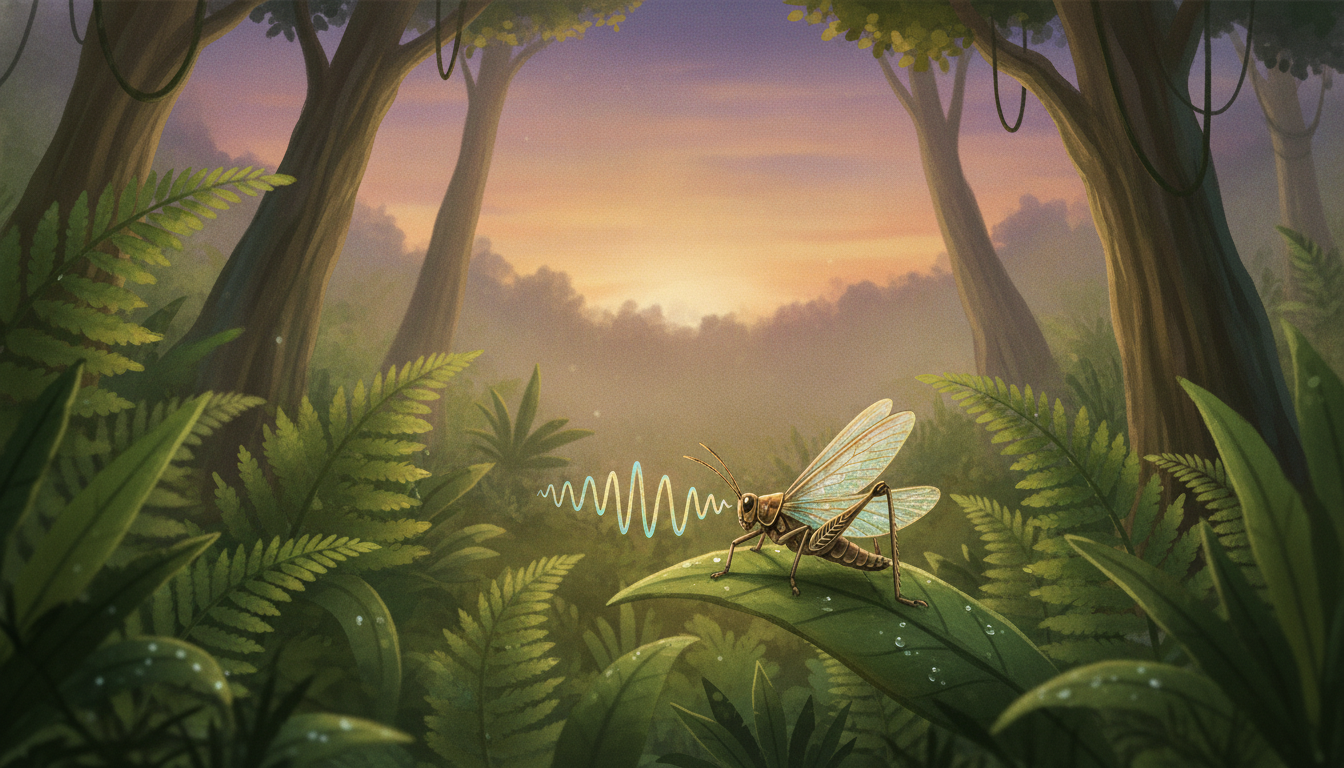
Sometimes, when the world gets a bit too loud, I find myself craving silence – true, deep quiet. But then I read something that completely flipped my perspective, reminding me that even in the most ancient, seemingly silent past, there was a symphony playing. Not roaring dinosaurs, mind you, although those were certainly part of the Jurassic soundscape, but something far more delicate and, honestly, quite profound: the chirps of insects, 165 million years ago.
Can you even imagine? Scientists, a brilliant bunch from places like the University of Graz, Lincoln, and Beijing, actually managed to recreate these sounds. I mean, it’s not like they found little Jurassic iPods, right? What they did was study incredibly well-preserved fossils of nine different grasshopper species from what is now Inner Mongolia. These tiny creatures, part of the Orthoptera order (think crickets and grasshoppers we know today), made sounds by rubbing specialized wing structures together – a process called ‘stridulation.’ The imprints left on these ancient wings? They were like musical notation, a blueprint for sound.
Using super sophisticated analyses, simulations, and even a bit of AI magic, these researchers, led by folks like Thorin Jonsson, could actually reconstruct the pitches and rhythms of these long-lost mating calls. They figured out the exact hertz! It revealed a world far richer, acoustically speaking, than we’d ever thought possible. Some species crooned low, pure notes, much like a modern cricket, while others hit those higher frequencies, almost like our contemporary leafhoppers. This isn’t just a first for insects; it’s the oldest sound *ever* reproduced by humans. That’s just wild, isn’t it?
And here’s a real head-scratcher: one species, a katydid relative named *Sigmaboilus peregrinus*, communicated in the ultrasonic range – between 20 and 22 kilohertz! That’s just above what we humans can even hear. What’s truly fascinating about this particular discovery is that *S. peregrinus* lived millions of years before the first known bat existed. For ages, scientists thought insects developed ultrasonic calls mainly to avoid bats, but this ancient little crooner totally upends that theory. It makes you wonder, doesn’t it? Perhaps it was a way to evade other predators, or maybe, just maybe, a male’s clever strategy to make his call stand out above the din of a bustling Jurassic night. A little ancient dating advice, if you will.
The 508 Takeaway
This whole story, for me, isn’t just about cool science; it’s a beautiful reminder to truly *listen*. Not just to the obvious sounds around us, but to the subtle hums, the quiet whispers, the things we might not even consciously register. It encourages a mindfulness that expands beyond our immediate present, urging us to consider the echoes of the past and the hidden layers of the natural world, even those beyond our hearing range. Imagine what ancient wisdom or forgotten beauty we might uncover if we just, well, paid a little more attention. Every moment, every tiny creature, has a story to tell, a sound to share, if only we attune ourselves to receive it. It makes me think about the unseen connections, the continuous thread of life, and how much richness exists just beneath the surface, waiting for us to notice.
This story was originally reported by Andy Corbley. You can read the full original article here.