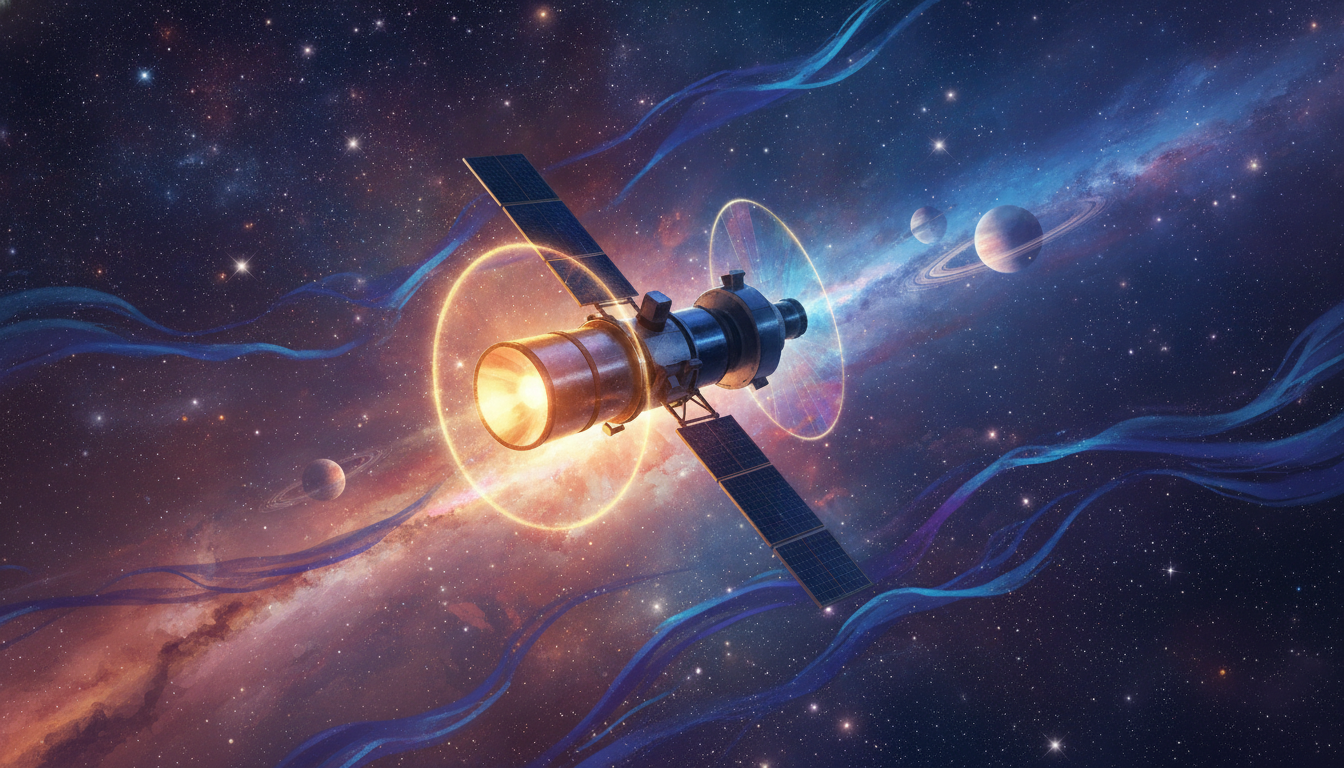
You know, sometimes I just stare up at the night sky and feel this incredible pull, this deep curiosity about what’s really out there. It’s a feeling I bet many of us share, a quiet wonder. And speaking of wonder, let me tell you about something truly mind-blowing that just happened: the Nancy Grace Roman Space Telescope, a new eye on the universe, successfully launched into space on Sunday afternoon from Cape Canaveral. And get this: it actually soared into orbit nine months *ahead* of schedule, despite some pretty significant attempts to cut its budget in half over the years. Talk about perseverance, right?
Named after the incredible American astronomy pioneer Nancy Grace Roman—a woman who, back in 1959, predicted we could actually measure light from exoplanets if we just blocked out their star’s glare—this telescope isn’t just another pretty face in the cosmos. While Hubble gives us those stunning nebulae and James Webb peers into the universe’s infancy with infrared, Roman, well, she’s got a different gig. She’s designed to be the wide-angle master, a cosmic cartographer, if you will. Her mission? To tackle the universe’s biggest, most mysterious secrets: dark matter and dark energy.
Sounds like something out of a sci-fi flick, doesn’t it? But these aren’t just theoretical concepts; they’re the invisible scaffolding and the pushing force that make up about 95% of everything! Dark matter pulls things together, building structures, while dark energy, the real head-scratcher, pushes things apart. Roman is going to map how galaxies move, charting these unseen forces across billions of years. Imagine, a century’s worth of Hubble’s mapping in just a month! That’s some serious cosmic hustle.
And then there’s the exoplanet hunt. That prediction Nancy Grace Roman made all those years ago? This telescope has a first-of-its-kind “active coronagraph” – basically, a super-advanced razor’s edge in space. It blocks out the blinding light of distant stars so we can actually *see* the planets orbiting them. We’re talking about going from seeing subtle light signatures at one part per million to a staggering one part per *billion*. If it works as spectacularly as they hope, we’ll be spotting Jupiter-sized exoplanets left and right, and maybe, just maybe, paving the way for future telescopes to find Earth-sized worlds. It’s like we’re finally stepping off that precipice into the unknown, as one senior project scientist, Julie McEnery, put it. It’s a truly thrilling time to be alive, watching humanity reach further than ever before.
The 508 Takeaway
This whole Roman Telescope saga, for me, is a beautiful reminder that there’s so much more to everything than meets the eye. Just like dark matter and dark energy silently shape the universe, there are often unseen forces, quiet kindnesses, or hidden strengths at play in our own lives. It encourages us to look deeper, past the obvious, to appreciate the intricate dance of existence. And the sheer human perseverance behind this mission—surviving budget cuts, pushing boundaries—well, that’s a powerful lesson in itself. It tells us that even when things feel impossible, or when the path ahead is unclear, maintaining a sense of wonder and a commitment to discovery can lead to breakthroughs, both cosmic and deeply personal. It’s about finding joy in the pursuit of the unknown, embracing the mystery, and remembering that every small step forward, every act of curiosity, adds to the grand, unfolding story.
This story was originally reported by Andy Corbley. You can read the full original article here.