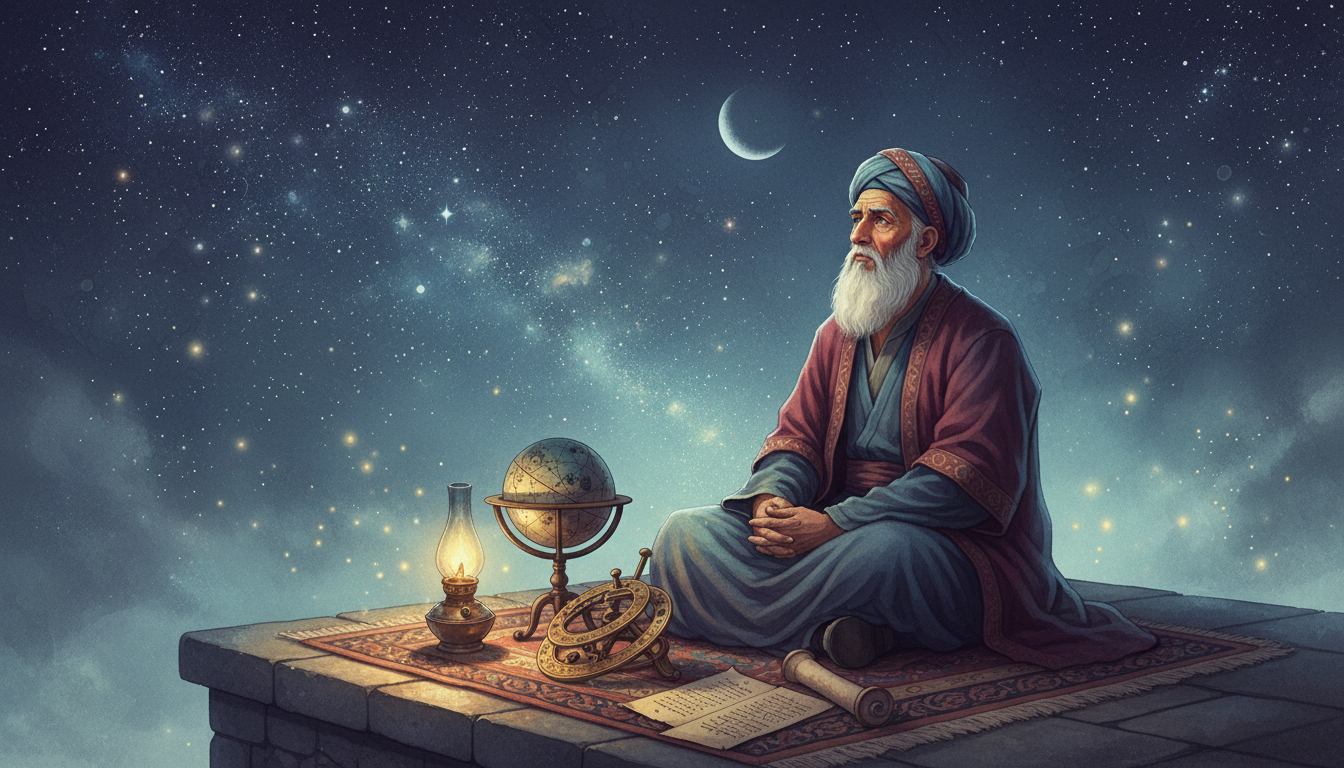
Picture this: it’s the 11th century, somewhere under the vast, inky canvas of the Persian night sky. No streetlights, no digital clocks, just the moon and a million glittering pinpricks of light. That’s the world a brilliant mind named Omar Khayyam inhabited, born exactly 978 years ago today, May 18th.
Now, you might know his name from a poem or two, but trust me, that’s just a sliver of his genius. Khayyam? He was an astronomer, a mathematician, a philosopher to boot—a true polymath, as they say. His big claim to fame, the one that still makes my jaw drop a little, was calculating the solar year with such incredible precision that the calendar he helped develop is *still* in use in Iran today. Think about that for a second. We’re talking about a guy, centuries before fancy telescopes and supercomputers, who could tune the length of a year so accurately it would barely shift in the sixth decimal place over a lifetime. That’s not just smart; that’s a deep, almost spiritual dedication to truth and observation, isn’t it?
He wasn’t just about the numbers, though. Khayyam saw things, you know? He lived in an age where, as he put it, ‘men of science are discredited, and only a few remain who are capable of engaging in scientific research.’ Ouch. Sounds a bit familiar, doesn’t it? He lamented how philosophers mixed true with false, interested only in ‘outward show.’ And if someone sincere sought truth, they’d be mocked. Crikey, that’s a sentiment that echoes across the millennia, doesn’t it?
The 508 Takeaway
What can we, living our bustling 21st-century lives, learn from an 11th-century Persian scholar? Plenty, I reckon. Omar Khayyam’s unwavering pursuit of precision, his commitment to seeing things as they truly are, offers a powerful lesson in mindfulness. It’s about slowing down, really looking, really listening, whether it’s to the rhythm of the seasons or the quiet whispers of truth within ourselves. In a world often loud with ‘outward show,’ his story reminds us to value genuine inquiry, to protect that quiet space for deep thought, and perhaps, just perhaps, to be a little kinder to those who dare to seek truth, even when it’s unpopular. It’s a call to find our own kind of precision, not just in measuring time, but in living it fully, authentically, and with a bit more clarity.
This story was originally reported by Good News Network. You can read the full original article here.