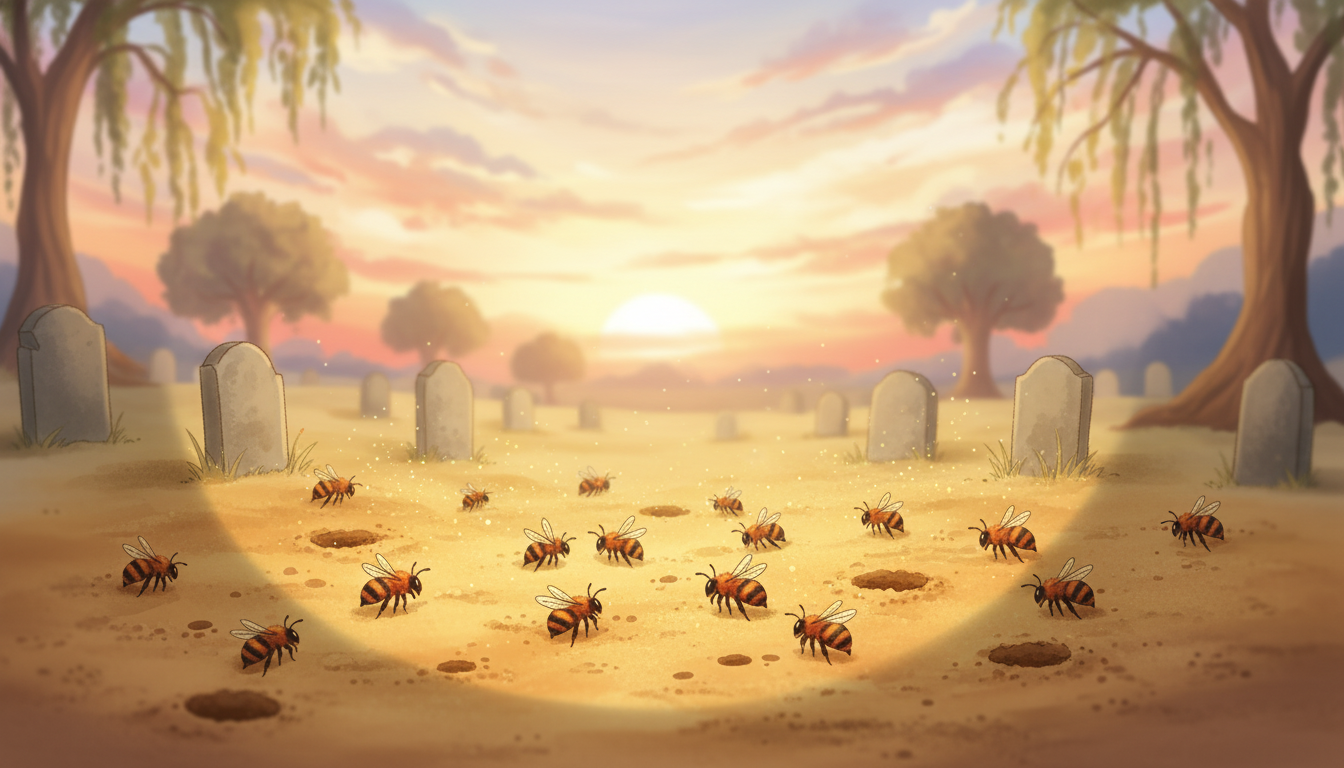
You know, sometimes the most incredible discoveries aren’t made by scientists in labs, but by folks just… living their lives. Like Rachel Fordyce, who used to take a shortcut through Ithaca’s East Lawn Cemetery on her way to work at a Cornell entomology lab. Probably just trying to save a few minutes, or maybe just enjoying the peace, you know? But one spring day in 2022, her usual path through the quiet graveyard wasn’t so quiet after all. It was buzzing. Literally.
Not just a couple of bees, mind you. She described it as “bees everywhere,” a living, shimmering carpet of movement across the sandy soil. I can just picture her, pausing, probably tilting her head a bit, then that little spark of curiosity — a true scientist, even off the clock. She scooped some into a jar, a spontaneous, almost casual act, and brought them to her supervisor, Bryan Danforth. “These are all over the cemetery,” she told him. Simple words, really, yet they unlocked a secret that had been humming along for over a century.
Turns out, these weren’t honeybees, no. These were *Andrena regularis*, the “regular mining bee,” a solitary species that nests underground, totally vital for pollinating crops like apples, a big deal here in New York. And what Rachel had stumbled upon? An aggregation of an estimated 5.5 million of them, spreading across 1.5 acres of that very cemetery. Five. Point. Five. Million. That’s more than double the human population of Manhattan! Can you even imagine? It’s like finding a bustling, vibrant, ancient city, alive with purpose, right beneath our feet, completely hidden in plain sight.
Scientists used these clever little mesh tents, called emergence traps, to get a handle on the population, and their findings were just astounding. This wasn’t some new phenomenon; historical records suggest these busy little miners have been calling that cemetery home since the early 1900s. A hundred years of quiet, persistent life, thriving in undisturbed soil, free from pesticides, perhaps even benefiting from the nearby Cornell Orchards. It really makes you think, doesn’t it? About all the unseen worlds that exist, just beyond our immediate perception.
The 508 Takeaway
This whole story, for me, is a beautiful, unexpected lesson from the natural world. It’s a profound reminder that magic isn’t always grand and obvious; sometimes, it’s a quiet hum underfoot, waiting for us to simply *notice*. How often do we rush through our days, our minds cluttered, missing the intricate dance of life happening all around us? Rachel Fordyce didn’t just walk; she *observed*. Her simple act of curiosity unveiled an entire ecosystem, a testament to the incredible resilience of nature and the unexpected havens found in places like old cemeteries. It urges us, I think, to slow down, to be present, to truly *see* the world with open eyes and a curious heart. And perhaps, too, it’s a gentle nudge towards kindness—a quiet understanding that every creature, no matter how small, plays a vital role. What if we all took a moment today, just one, to look a little closer, listen a little harder, for the secret lives bustling around us? We might just discover our own unexpected corner of wonder, a quiet joy, proving just how interconnected and miraculous everything truly is.
This story was originally reported by Andy Corbley. You can read the full original article here.