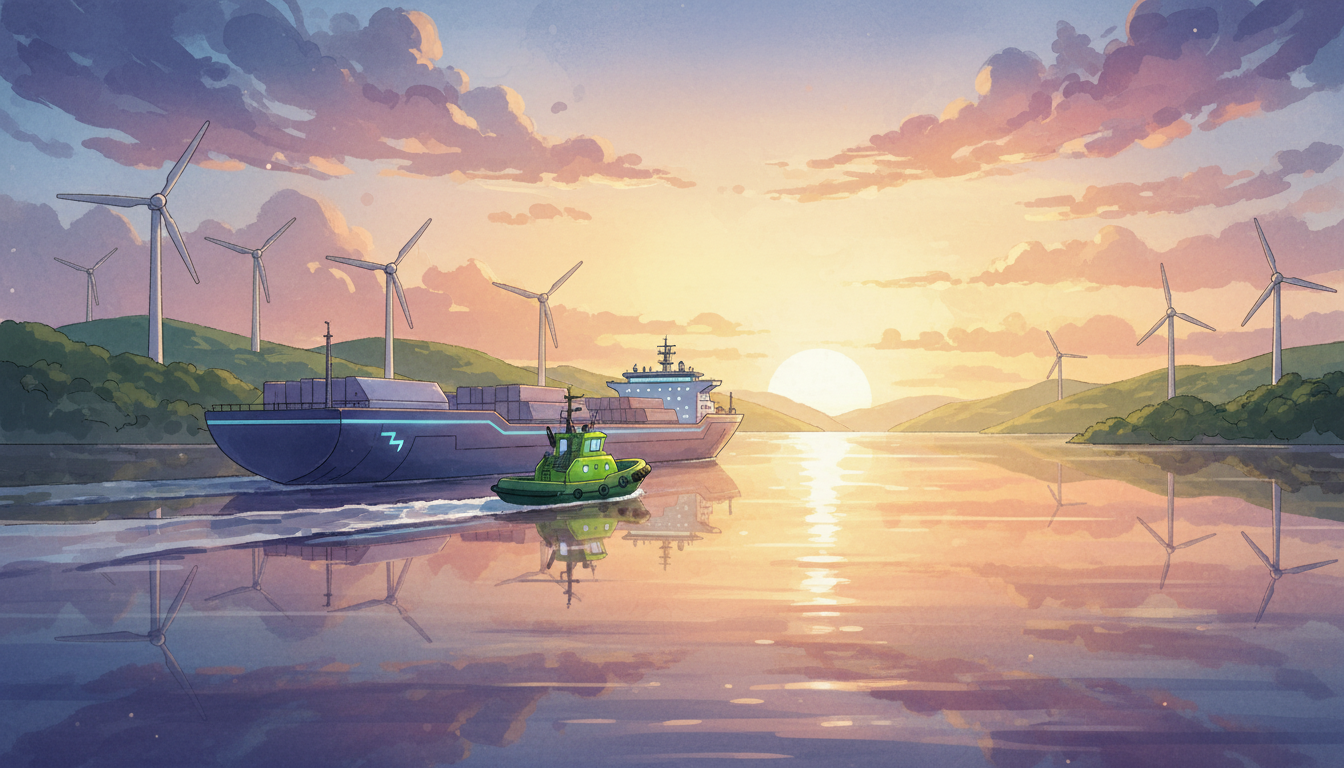
Just the other day, I caught myself staring out at the harbor, watching a colossal cargo ship — one of those behemoths that look like floating cities — glide almost silently across the water. It got me thinking about the sheer, mind-boggling scale of global trade, and honestly, the equally massive environmental footprint that comes with it. We talk a lot about electric cars, right? Even electric planes are on the horizon. But these ocean giants? They’ve always felt like this impossible challenge, guzzling heavy, dirty fuels, a necessary evil, it seemed, for our interconnected world.
Well, get this: I stumbled upon some news that absolutely *blew my mind*. The world’s biggest battery maker, a Chinese company called CATL, which, by the way, already controls over a third of the global market for EV batteries (that’s huge!), has declared it’s going “all in” on electrifying marine shipping. Like, *really* all in. They’re planning to double their maritime applications division, focusing first on those near-shore vessels, the tugboats and ferries that are constantly buzzing around our ports.
Now, I’m no engineer, but I get that powering a ship is way different than powering a car. You need a *lot* more oomph to push through water than through air. That’s why, historically, batteries just haven’t been practical for the high-density energy required for massive cargo ships. But things are changing, and fast. The cost of lithium-ion batteries? It’s plummeted 90% in the last two decades. That’s a staggering figure, isn’t it? And this company, CATL, they’ve got a clever idea, too: a battery-swap model for near-shore vessels. Imagine a tugboat pulling into a dock, swapping out its depleted battery for a fully charged one, and just like that, it’s back to work. Round-the-clock operations, totally electric. They’ve already seen success with this in long-haul trucking, so it’s not just a pipe dream.
This isn’t just some small-fry startup, either. We’re talking about a company that saw 42% revenue growth last year, topping $10 billion. When a powerhouse like that says they’ll “spare no effort” in R&D and building a supply chain for this, you just know it’s a game-changer. It feels like a genuine turning point for an industry that desperately needs one.
The 508 Takeaway
What strikes me most about this isn’t just the technological marvel, though that’s pretty incredible on its own. It’s the sheer audacity of the vision, the unwavering commitment to tackle what felt like an insurmountable problem. It reminds me that even the most daunting challenges, whether they’re global emissions or a personal struggle, can be approached with ingenuity and a willingness to simply *try*. Sometimes, finding joy and peace in our everyday moments isn’t about ignoring the big, scary stuff, but about recognizing the quiet, persistent efforts being made to make things better. This news, for me, is a gentle nudge to remember that progress, much like kindness, often starts with a single, determined step – or in this case, a whole lot of battery power – and ripple outwards, changing the currents of our world in profound ways. It’s a quiet hope, isn’t it?
This story was originally reported by Andy Corbley. You can read the full original article here.