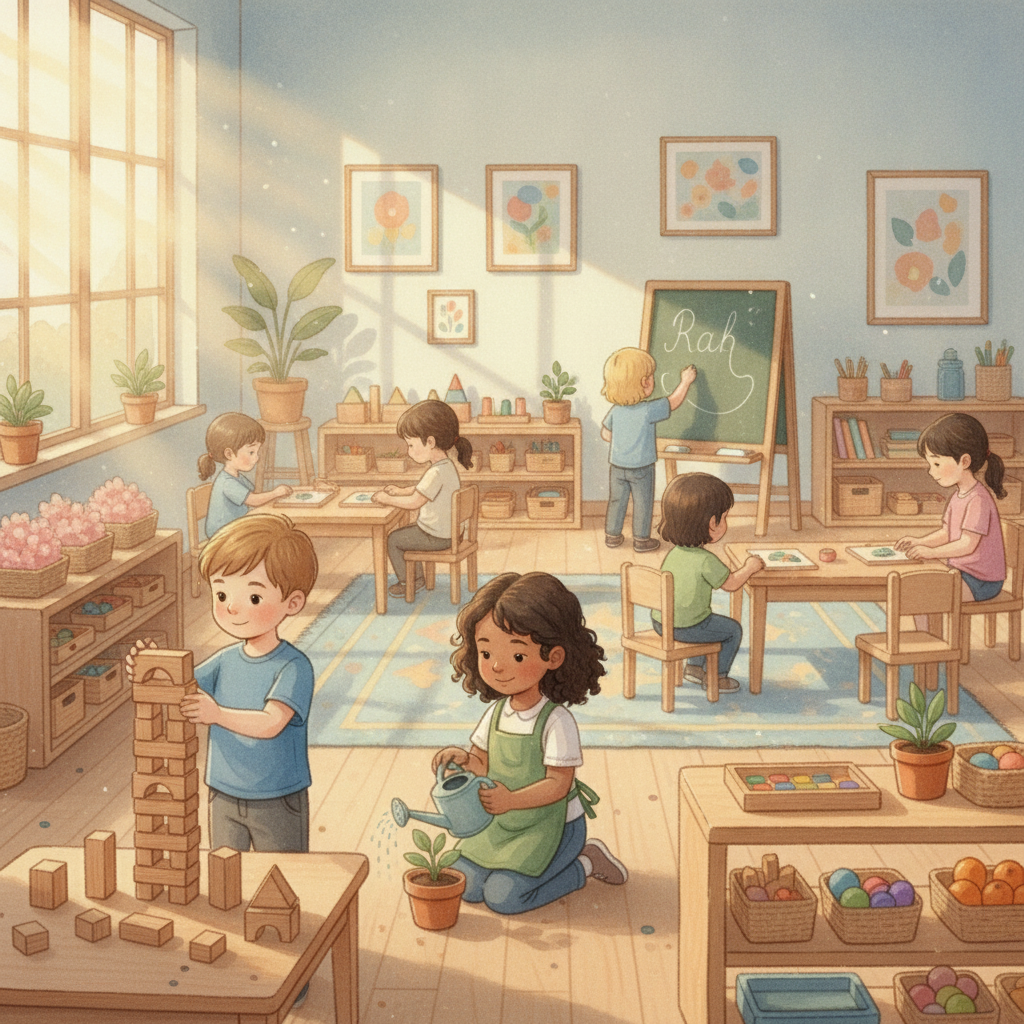
You know that feeling when a child gets completely lost in an activity, utterly absorbed, time just… vanishing? I was watching my niece the other day, meticulously stacking blocks, completely in her own world, and it hit me: this is exactly what Maria Montessori saw, and what she built an entire educational philosophy around, way back in 1870. It wasn’t about rote memorization or forcing kids into a mold; oh no, not at all. It was about something far more beautiful and, frankly, revolutionary.
Montessori, a real trailblazer—she was one of Italy’s first female physicians, mind you—noticed something profound: children have these inherent, individual gifts. Each one a unique little universe, ready to explore. Her big idea? It wasn’t the teacher’s job to dictate what a child *should* know by a certain age, but rather to help them *find* and *develop* those passions, those gifts, on their own terms. Pretty wild for the late 19th century, right?
So, she created these incredible environments: mixed-age classrooms where kids could learn from each other, where independence was the name of the game. Imagine, a three-year-old and a six-year-old side-by-side, one helping the other, both totally engaged in activities of *their* choice, sometimes for hours. No bells, no frantic schedules. Just focused, joyful discovery. She even designed child-sized tables and chairs, which, I mean, seems so obvious now, but was a game-changer back then. It’s a bit of a mind-bender, really, how simple yet powerful her insights were. Her schools have popped up all over the world, a testament to her vision. She wrote books, too, like ‘The Montessori Method’ and ‘The Absorbent Mind,’ sharing her wisdom with anyone who’d listen. It wasn’t just about schooling, it was about respecting the human spirit from its very beginning.
The 508 Takeaway
What Maria Montessori figured out for kids, I think, holds a deep truth for us adults too. How often do we truly allow ourselves to get lost in something we love, without a specific ‘outcome’ in mind? Her philosophy reminds us to honor our own inherent curiosities, to give ourselves the space for self-directed exploration, and to perhaps, just perhaps, rediscover that pure, unadulterated joy of learning for learning’s sake. It’s about being mindful of our own inner promptings, finding our unique rhythm, and embracing a kindness towards our own growth journey, remembering that every moment can be a chance to engage deeply, just like that child with the blocks.
This story was originally reported by Good News Network. You can read the full original article here.