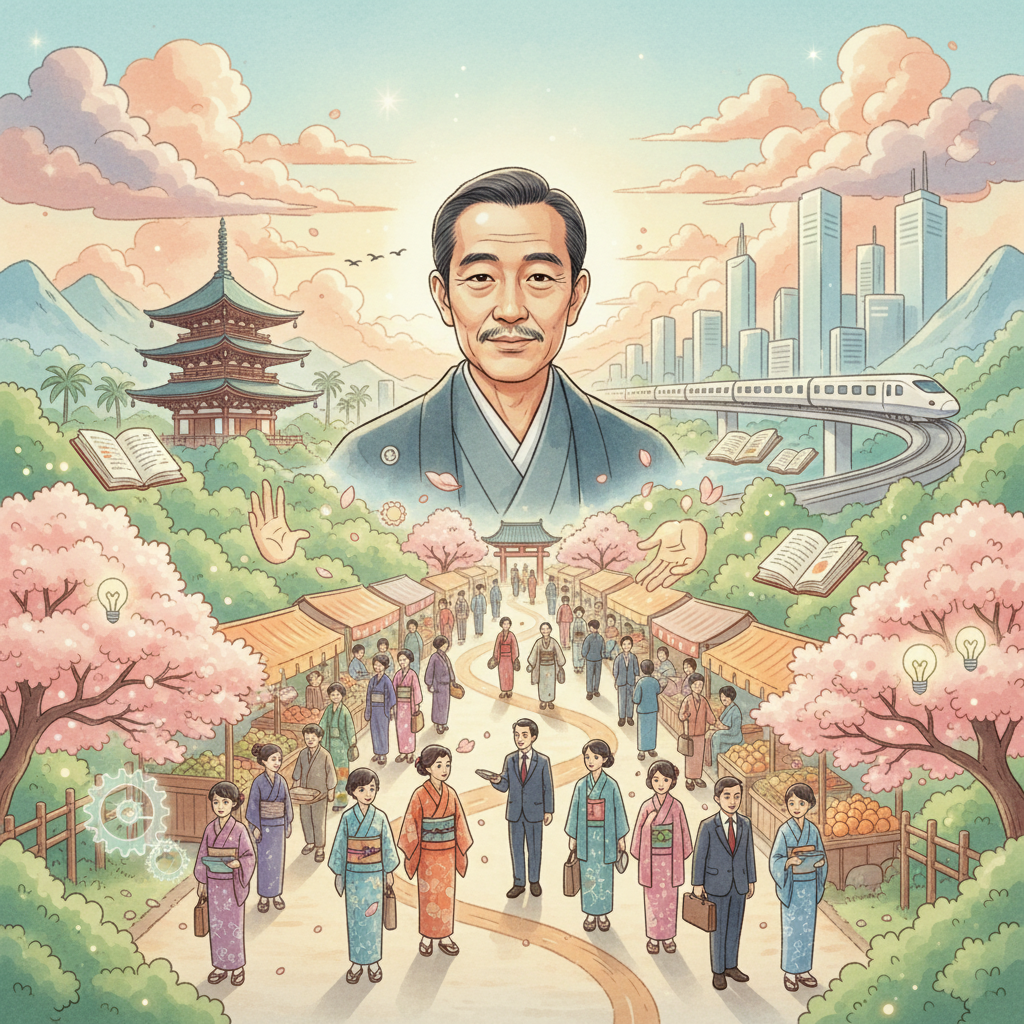
You know, sometimes you stumble upon a story that just… changes how you think about things. I was reading the other day, just casually, about this fellow, Shibusawa Eiichi, whose face now graces Japan’s 10,000 yen note. And honestly, my first thought was, ‘Who *is* this guy?’ Because, let’s be real, seeing someone on currency usually means they’re a big deal, right? But the *kind* of big deal he was? That’s the real kicker.
Turns out, Eiichi, born way back in 1840, wasn’t just some dry economist. Oh no. This guy, in his youth, almost became a full-blown domestic terrorist, plotting to torch a castle! Can you even imagine such a pivot? Instead, he ended up in Kyoto, then traveled to Paris for the Universal Exposition in 1867. That trip, I reckon, really opened his eyes to Western ideas, especially around business and finance. He came back to Japan amidst the Meiji Restoration – a time of immense change, you know? And instead of, well, *arson*, he focused on building. He established the Shōhō Kaishō, one of Japan’s first joint-stock companies. Then, in 1873, he became the president of the Dai-ichi Bank, Japan’s very first modern bank. Pretty wild, huh?
What’s truly fascinating, though, is his philosophy. Eiichi believed, with all his being, that business *had* to have strong ethics. And it sounds so obvious now, doesn’t it? But back then? In a rapidly industrializing nation? It was revolutionary. He didn’t just preach it; he lived it. The sheer number of companies the Dai-ichi Bank helped kickstart – many still major players on the Tokyo Stock Exchange today – is a testament to his vision and, frankly, his uncanny eye for potential. We’re talking Mizuho Financial Group, Imperial Hotel, Tokyo Stock Exchange itself, Tokyo Gas, even Sapporo Breweries. A real ‘Warren Buffett before Buffett’ kind of guy, if you catch my drift.
But here’s the part that really got me. Like many wealthy industrialists, he poured his fortune into education and social welfare, supporting over 600 philanthropic causes. Six hundred! Yet, despite all this, he never, ever owned controlling stakes in any of the companies he invested in. His reasoning? He didn’t want to disrupt what made them successful. Think about that for a second. That’s a level of humility and long-term thinking you just don’t see every day, is it? He was nominated for the Nobel Prize, for goodness sake, and now, his face is on the money. Fitting, I suppose, for a man who helped shape an entire economy with kindness at its core.
The 508 Takeaway
Shibusawa Eiichi’s story, for me, really hammers home a powerful truth: our actions, especially those rooted in ethical purpose and a genuine desire to uplift others, echo for generations. It’s a reminder that ‘success’ isn’t just about accumulating wealth or power; it’s about how we use our influence to build something better, something truly sustainable. Imagine if more leaders, in every field, approached their work with that kind of selfless vision – that willingness to empower without needing to control. It encourages us, doesn’t it, to look beyond immediate gains and think about the wider ripple effect of our choices? To infuse our daily tasks, big or small, with a sense of integrity and a quiet commitment to the common good. That, I believe, is where true joy, and lasting legacy, really lie.
This story was originally reported by Good News Network. You can read the full original article here.